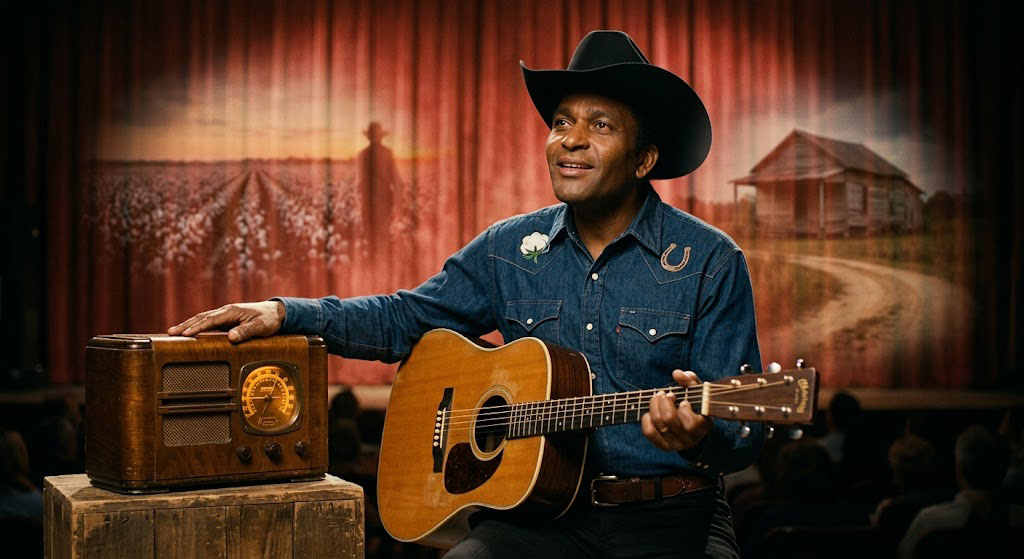
THEY CONCEALED HIS FACE JUST TO GET HIS RECORDS PLAYED ON THE RADIO — THEN HE SANG THE EXACT STORY THEY WANTED HIM TO FORGET…
In the mid-1960s, the country music establishment simply did not know what to do with Charley Pride. Nervous record executives shipped his early singles to powerful radio stations without a single promotional photograph attached.
They firmly believed conservative audiences would instantly reject a Black country singer. So they completely erased his image, hoping his rich, undeniable baritone could survive quietly in the dark.
It was a calculated gamble to slip past the prejudice.
THE HEAVY SILENCE
The strategy worked perfectly, but the strict anonymity could never last forever.
When Charley finally walked onto a brightly lit stage for his first major concert, a stunned, heavy stillness fell over the enormous crowd. Thousands of people suddenly realized the traditional, comforting voice they loved belonged to a Black man.
He did not get angry. He did not retreat.
He just stepped up to the microphone and smiled. He delivered a gentle, disarming joke about his “permanent tan,” breaking the tension before playing his very first chord. The room went quiet, and then they just listened.
He conquered the very radio stations that once feared him. He amassed twenty-nine number-one hits and became the Country Music Association’s Entertainer of the Year. His monumental record sales eventually trailed only Elvis Presley at RCA.
He proved the entire world wrong.
THE DELTA DUST
But the absolute true measure of his quiet rebellion came much later in his career.
Charley could have spent the rest of his life comfortably outrunning his painful past. He could have easily coasted on universal heartbreak songs to carefully protect his hard-won, historic status in Nashville.
Instead, he went back into the studio and recorded “Mississippi Cotton Pickin’ Delta Town.”
This track was not a fictional, polished narrative written by a Music Row songwriter. It was an unfiltered, honest map leading straight back to his childhood. He sang openly about the blinding dust, the relentless sweat, and the heavy cotton rows he worked before he could even read.
He was born into a poor sharecropping family in Sledge, Mississippi.
As a young boy, he picked cotton alongside ten siblings under a merciless sun. Yet, every Saturday night, his father would carefully tune a crackling Philco radio to catch the Grand Ole Opry broadcast.
Those distant, static-filled voices planted a dangerous dream in a place where it was never supposed to grow.
NAMING THE TRUTH
When Charley performed that specific song, he was not just entertaining a crowd. He was naming his absolute truth plainly.
He did not polish his difficult past until it became unrecognizable. He brought the Delta dirt, the sharecropper’s porch, and his family’s deep struggle right onto the most sacred stages in country music.
He carried his history into a genre that often celebrated rural life while systematically refusing to see everyone who actually lived it.
He did not demand a sudden apology from the industry. He just made the music so incredibly beautiful that they had absolutely no choice but to let him stay.
He proved that the deep roots they once forced him to hide were the exact reason his legacy will echo forever…