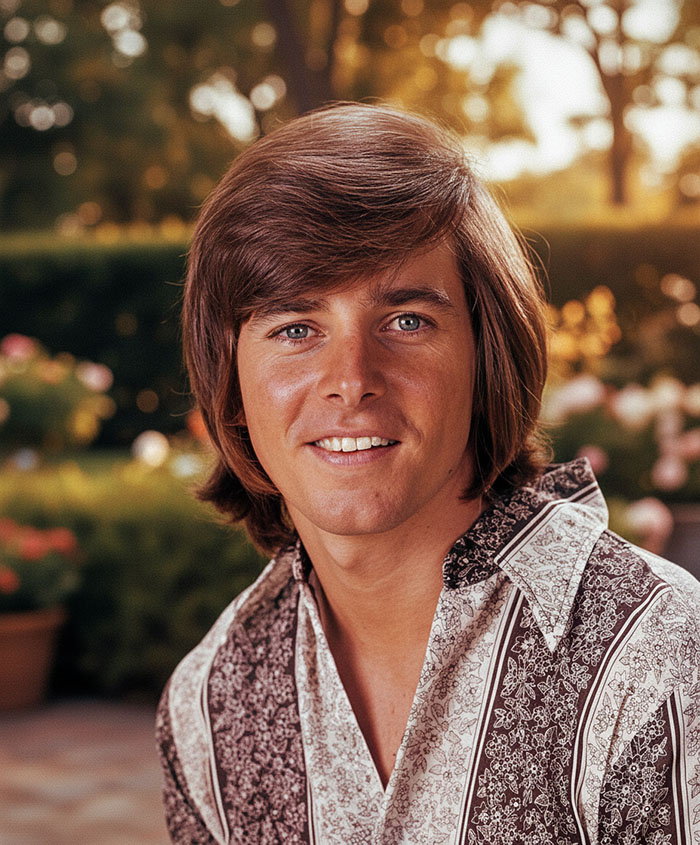
EARLY IN THE MORNING DIDN’T SOUND LIKE A SCREAMING TEEN-IDOL MOMENT — IT SOUNDED LIKE THE LIGHTS AFTER EVERYONE HAD GONE HOME.
Bobby Sherman was once the face on bedroom walls, the smile in magazines, the young man whose voice could make a room full of teenagers lose their breath.
For a generation, he was sunshine with a microphone.
But “Early in the Morning” carried a different kind of light.
It wasn’t the loudest song in his story. It wasn’t the one most people name first when they remember the Bobby Sherman years — not before “Little Woman,” not before “Julie, Do Ya Love Me,” not before the television glow of Here Come the Brides.
And maybe that is why it matters.
Because some songs don’t arrive like fireworks. Some songs slip in like morning through a kitchen window, touching the table after a long night, finding the quiet places a bigger hit never could.
Bobby had built his fame on charm — the clean smile, the easy warmth, the kind of presence that made America feel younger for a few minutes. In the late 1960s and early 1970s, he belonged to that bright, fast-moving world where music, television, and teenage dreaming all seemed to happen at once. He was a teen idol, an actor, a pop singer, and for millions of fans, a first crush wrapped in melody.
But behind every poster is a person time keeps changing.
And when Bobby sang “Early in the Morning,” there was something gently human in it — not a boy trying to conquer a stage, but a voice moving through the kind of hour when people remember what they have lost, what they left unsaid, and what still waits for them when the noise is gone.
That is the ache of the song.
Morning should mean a beginning.
But in this song, it feels like the moment after something has already happened.
The party is over. The phone is silent. The road outside is pale. Somewhere, someone is awake before the rest of the world, carrying a feeling they cannot quite explain.
That was always the secret power of Bobby Sherman when he slowed down.
The fans came for the smile.
But the songs that lingered often gave them something softer — a place to put their own loneliness without having to name it.
“Early in the Morning” was released later in his hit-making run, when the flash of teen-idol fame was already beginning to meet the harder truth of time. His version appeared as a 1972 single, a quieter entry compared with the million-selling records that had made his name glow so brightly.
And yet, for the people who kept that record, who heard it on a turntable or a small radio in a room with wood-paneled walls, it became more than a chart position.
It became a sound attached to a season of life.
That is where the throat catches.
Not because the song tries to break your heart.
But because it understands that some sadness comes softly.
It comes while the coffee is still warm.
It comes when sunlight lands on an empty chair.
It comes when a voice from decades ago suddenly makes you remember who you were when you first heard it.
Bobby Sherman’s life later moved far beyond the spotlight. After fame, he became known for public service, working in emergency medical training and law enforcement-related service — a turn that made his story feel even more revealing. The boy on the poster grew into a man who chose usefulness over applause.
That detail changes the way his music feels now.
Because when “Early in the Morning” plays today, it is not just nostalgia for a handsome young star. It is the sound of time passing through one life and into ours.
Bobby is gone now, but songs like this do not leave the room the way people do.
They stay in the old places.
In the first light.
In the memory of a record sleeve.
In the voice that made someone young feel understood before they had the words for it.
And maybe that is why “Early in the Morning” still feels so tender.
It reminds us that every bright star eventually meets the quiet hour.
But sometimes, if the song is honest enough, the morning keeps the voice.