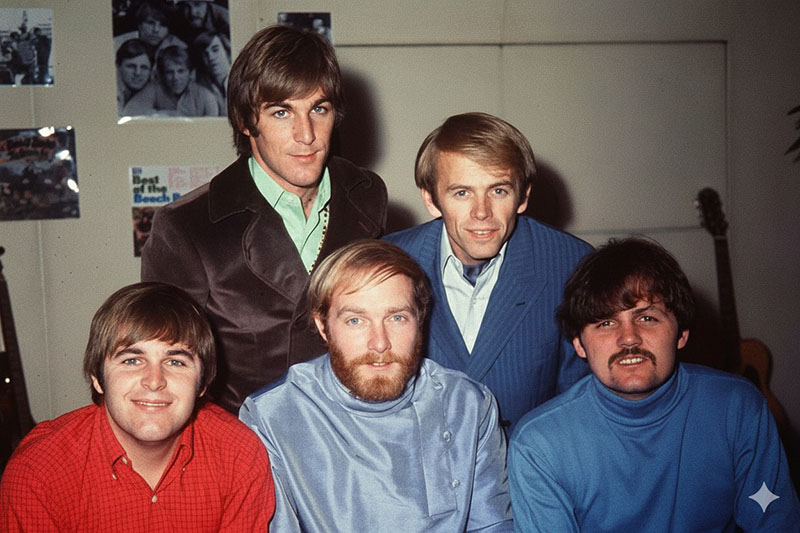
409 WAS ONLY A CAR SONG ON PAPER — BUT INSIDE THAT ENGINE, THE BEACH BOYS WERE ALREADY CHASING AMERICA’S DREAM.
Before the world fully understood The Beach Boys, before the harmonies became stained glass, before California became something you could hear, there was a hot rod, a teenage heartbeat, and the sound of young men trying to outrun ordinary life.
“409” was not built like a confession.
It did not walk into the room carrying heartbreak. It did not ask anyone to cry. It came roaring in with chrome, gasoline, handclaps, and that bright early Beach Boys confidence — the kind that made everything sound possible if the radio was loud enough.
But that is what makes the song so strangely beautiful now.
At first, it sounds simple: boys singing about a Chevrolet engine, the famous 409 cubic-inch V8, a machine that meant speed, pride, and Saturday-night status in the early 1960s. It was car culture turned into harmony.
Yet beneath the shine, there was something deeper happening.
The Beach Boys were not just singing about a car. They were singing about escape.
They were singing about the feeling of being young enough to believe a road could save you, a motor could make you somebody, and a night drive could carry you far beyond the small fears waiting at home.
You can hear it in the way the song moves.
It does not stroll. It jumps.
The voices stack together like headlights on a dark highway. The rhythm feels impatient, as if the whole record is leaning forward. Even the joy has urgency in it.
That was the gift of The Beach Boys at the beginning.
They could take something as ordinary as a car engine and make it feel like a whole country dreaming through a dashboard.
For some listeners, “409” brings back the smell of summer pavement, the weight of a first set of keys, the sacred importance of a clean shirt on a Friday night. For others, it is the sound of an America they only inherited through old records, family stories, garage walls, and fathers who once knew every engine by ear.
And maybe that is the ache hidden inside the song.
The Beach Boys made youth sound endless.
But no youth ever is.
That engine keeps revving on the record, but the people who first heard it through tiny speakers grew older. Cars rusted. Drive-ins disappeared. The kids in letterman jackets became parents, then grandparents. Some of the voices behind the song carried burdens the public could not fully see from the outside.
Still, “409” stayed bright.
That is not because it ignored time.
It is because it captured one moment before time could touch it.
There is a very human detail in that: the way a song can preserve a version of ourselves we cannot get back. A boy leaning over an engine. A girl pretending not to watch. A radio glowing in the dash. A streetlight hitting the hood of a car like a small spotlight.
For two minutes, nobody has to explain what was lost.
The record simply starts, and suddenly the years move aside.
That is the quiet power of “409.” It reminds us that not every important song has to sound wounded. Some songs hurt later, because they were so alive when we first heard them.
The Beach Boys would go on to make deeper, stranger, more sophisticated music. They would build cathedrals out of longing and harmony. But “409” matters because it catches them at the edge of the starting line — before the myth grew heavy, before innocence became memory.
It is the sound of boys believing the whole world might be waiting just past the next green light.
And maybe, after all these years, that is why the song still works.
Not because every listener cared about a Chevrolet 409.
But because everyone remembers wanting something that could take them away.
A car.
A song.
A night.
A road.
And somewhere in that bright little engine, The Beach Boys left the key turned for all of us.