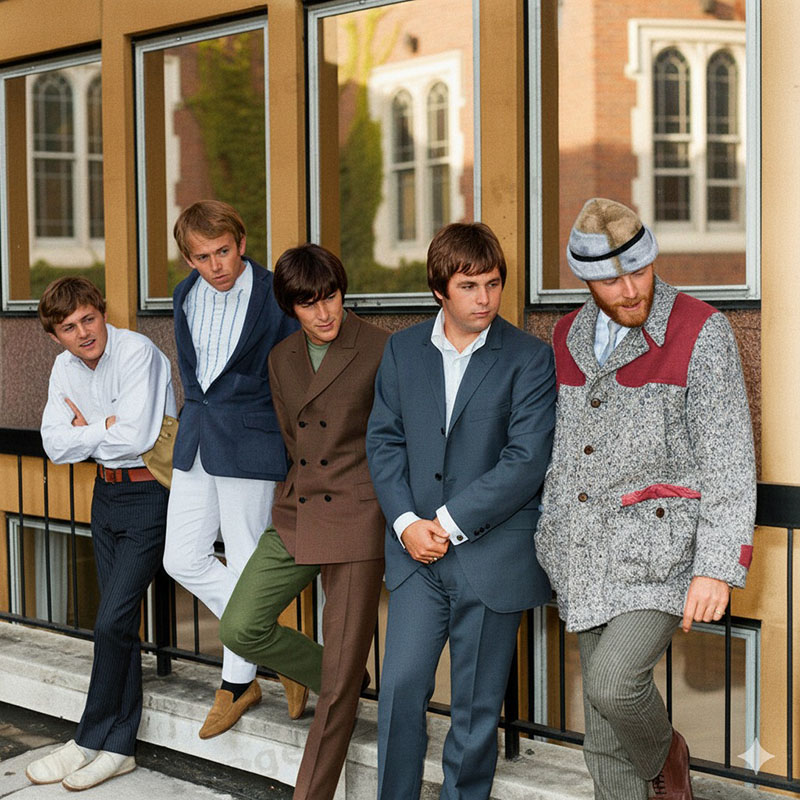
“HEROES AND VILLAINS” SOUNDED LIKE A WESTERN DREAM — BUT BENEATH THE LAUGHTER, SOMETHING STRANGE AND LONELY WAS RIDING THROUGH.
It did not sound like an ordinary pop song.
It did not walk into the room neatly, shake your hand, and explain itself.
“Heroes and Villains” arrived like a half-remembered movie playing in the back of Brian Wilson’s mind — saloons, dusty streets, strange laughter, old America, young America, innocence, danger, carnival voices, and a story that seemed to keep changing every time you reached for it.
That was part of its beauty.
The Beach Boys had already given the world sunlight. They had given teenagers cars, waves, girls, harmonies, and the feeling of California as a place where the radio was always warm.
But this song was different.
This was not just the beach anymore.
This was a whole strange country.
“Heroes and Villains” felt like Brian Wilson opening a door inside the American songbook and finding ghosts standing there — cowboys, outlaws, childhood memories, broken myths, and the uneasy feeling that the line between the good guys and the bad guys was never as clean as people wanted it to be.
On the surface, it could almost feel playful.
The voices bounce. The melody shifts. The harmonies appear and disappear like characters ducking through swinging doors. There is humor in it, a kind of oddball theatrical grin, as if the band is staging a little frontier show for anyone brave enough to follow along.
But underneath that playfulness was pressure.
You can hear it in the way the song refuses to sit still.
It changes rooms. It changes moods. It starts like a story, then becomes a puzzle, then turns into a memory. It feels handmade, obsessive, beautiful, and slightly haunted — the sound of someone trying to build an entire world out of fragments before the world inside him slipped away.
That is what makes “Heroes and Villains” so unforgettable.
It is not only a song.
It is a mind at work.
Brian Wilson was not just arranging notes. He was chasing a feeling most artists would have left alone because it was too strange, too slippery, too hard to explain. He wanted the record to move like imagination itself — not in straight lines, but in flashes.
A voice here.
A piano there.
A sudden harmony that feels like sunlight through a cracked window.
Then the shadow returns.
For listeners who first expected another clean Beach Boys anthem, this song must have felt almost confusing. Where was the simple escape? Where was the easy summer? Where was the boy-meets-girl story that fit neatly inside three minutes?
Instead, they got something stranger and braver.
They got a song about America dressed as a dream.
And maybe that is why it has grown deeper with time.
Because life rarely divides itself into heroes and villains as neatly as old stories promise. The people we love can hurt us. The people who hurt us can still be remembered with tenderness. The past can look golden from a distance and complicated up close.
The song seemed to understand that without ever explaining it.
There is a moment when the music feels almost weightless, as if all those voices are lifting the listener above the dust for just a second. Then the song turns again, and you realize it was never trying to give you a stable place to stand.
It was trying to show you how unstable memory can be.
That is the ache hidden inside the spectacle.
Behind the playful title was a deeper loneliness: the loneliness of a genius hearing a world nobody else could fully hear yet, trying to make a band, a studio, and a few minutes of tape hold something far bigger than a hit single.
“Heroes and Villains” still feels alive because it never became simple.
It remains strange.
It remains beautiful.
It remains like an old radio picking up signals from a frontier town that may never have existed, except somewhere in the imagination of a man who could turn confusion into harmony.
And when the song fades, it leaves behind more than a melody.
It leaves behind the feeling of riding through your own past, wondering who the heroes were, who the villains were, and whether time has a way of making every story softer, sadder, and harder to name.