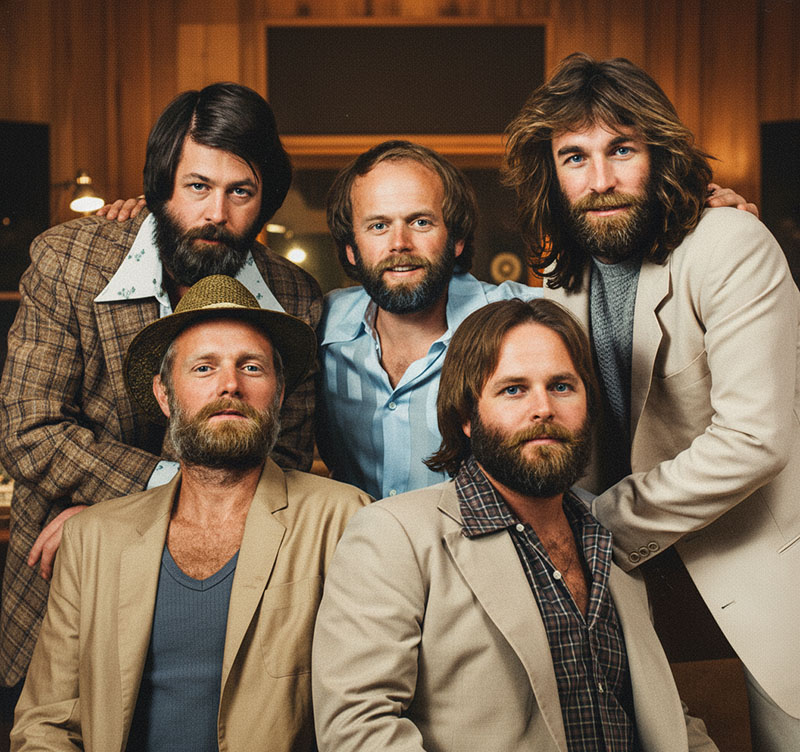
 Please scroll down for the music video. It is at the end of the article! 👇👇
BARBARA ANN SOUNDED LIKE A PARTY — BUT ITS REAL MAGIC WAS HOW LITTLE IT TRIED TO BE PERFECT.
Some songs arrive dressed like masterpieces.
“Barbara Ann” came in laughing.
It did not need a grand entrance. It did not sound polished into glass. It sounded like somebody had opened the door to a room full of friends, let the tape roll, and trusted that joy did not have to stand still to be remembered.
That is why it still feels alive.
The Beach Boys were already known for harmony so clean it seemed touched by sunlight. They could make a coastline feel like a choir. They could turn cars, beaches, girls, and summer into a whole American dream. By the mid-1960s, their sound had become almost impossibly bright.
Then came “Barbara Ann.”
A cover of The Regents’ doo-wop hit, it could have been treated like a museum piece, polished and carefully placed under glass. Instead, The Beach Boys made it feel wonderfully human — loose, loud, slightly wild, and full of the kind of shared energy that cannot be manufactured.
That is the secret beneath the nonsense syllables.
“Ba-ba-ba, ba-Barbara Ann” is not a deep lyric on paper.
But records do not live on paper.
They live in kitchens, car seats, bowling alleys, beach houses, family reunions, old radios, and late-night singalongs where nobody remembers the verses but everybody knows when to jump in.
The song does not ask you to understand it.
It asks you to join it.
And maybe that is why “Barbara Ann” has lasted. It carries a kind of happiness that feels almost endangered now — unfiltered, communal, a little messy, the kind that happens before anyone checks how they look from the outside.
There is something painfully sweet about that.
Because the more time passes, the more you realize how rare those moments are. The room full of voices changes. The friends move away. The old car gets sold. The record collection goes into a box. The people who once sang along without embarrassment become names you think about quietly when an old song catches you off guard.
Then “Barbara Ann” starts.
Suddenly, the years do not disappear exactly.
They loosen.
You can almost hear it: somebody clapping too early, somebody laughing off-mic, a harmony landing like a grin, the whole song wobbling with the joy of being together. It feels less like a performance than a memory somebody forgot to edit.
That is the ache hidden inside its happiness.
Not sadness.
Ache.
The ache of knowing that some of the best nights of our lives did not look important while they were happening. No spotlight. No announcement. Just a room, a song, and people singing badly enough to prove they were happy.
The Beach Boys understood something beautiful here, maybe without needing to say it: perfection can impress you, but imperfection lets you in.
“Barbara Ann” lets everybody in.
It belongs to the lead singer and the background voices, to the band and the crowd, to teenagers discovering it for the first time and grandparents who remember when it felt new. It belongs to anyone who has ever rolled down a window and sung louder than they had any right to.
That is the moment that catches in the throat now.
A silly chorus becomes a doorway.
You hear those voices bouncing around, and for a second, you are not just listening to The Beach Boys. You are back inside some ordinary American night that became precious only after it was gone.
Maybe there was a screen door.
Maybe a paper cup.
Maybe a dashboard glowing green.
Maybe someone beside you who is no longer easy to call.
And still, the song keeps smiling.
That is its grace.
“Barbara Ann” never pretended to carry the weight of the world. It carried something smaller, and maybe harder to preserve — the sound of people having fun before time came asking for everything back.
The Beach Boys gave us many songs that shimmered like summer.
But “Barbara Ann” gave us the sound of the party itself: imperfect, unforgettable, and still loud enough to bring old voices back into the room.
Ba-ba-ba.
And just like that, somebody you used to be starts singing too.