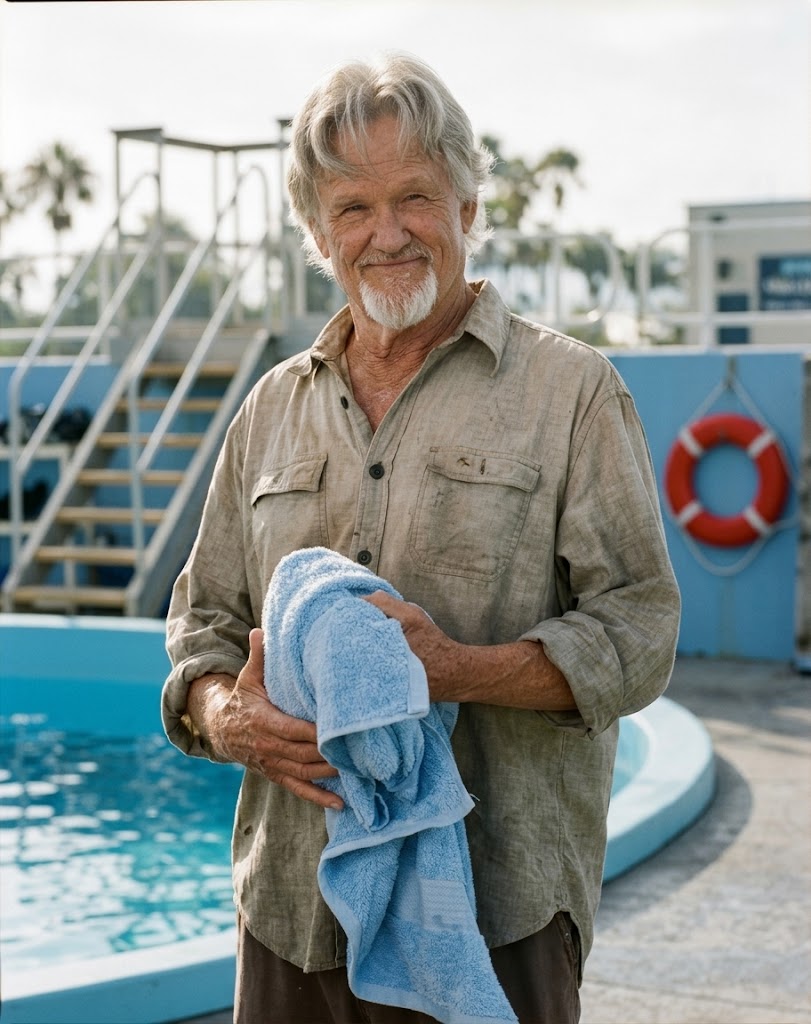
HE GAVE A BROKEN GENERATION THE WORDS TO SURVIVE — BUT WHEN HIS OWN MEMORY FADED, ONE NIGHT PROVED THAT A TRUE SOUL NEVER FORGETS A MELODY.
Kris Kristofferson didn’t just write country music. He completely dismantled it, tore down the polished walls of Nashville, and rebuilt it with the bruised, poetic truth of the streets.
He was the golden boy who was supposed to have it all. An Oxford Rhodes Scholar. A Golden Gloves boxer. An Army Ranger.
But he threw away a comfortable future, a prestigious military career, and his family’s expectations for a broom.
He swept floors at Columbia Studios, emptying ashtrays and watching Bob Dylan record, just to breathe the same air as the legends.
He was a janitor with a towering intellect and a notebook full of desperate, beautiful words.
The industry ignored him for years. So, he did what only a true outlaw would do: he landed a stolen National Guard helicopter right on Johnny Cash’s front lawn, just to hand him a demo tape.
That audacity gave the world “Sunday Mornin’ Comin’ Down.”
He gave us “Me and Bobby McGee,” “Help Me Make It Through the Night,” and “Loving Her Was Easier.”
He took the quiet, aching loneliness of a hangover, the cold reality of the American highway, and the silent regrets of a broken heart, turning them into undeniable art.
America saw the rugged movie star, the towering Highwayman, the ultimate ragged philosopher.
But behind the towering legend, a quieter, much harder battle was taking place.
At the absolute height of his fame, the man who wrote the most beautiful lines about pain was self-destructing. He often needed a drink just to find the courage to face the roaring crowds.
In 1980, facing a grim ultimatum from his doctor about his failing health, he finally put the bottle down. He chose his life over the legend.
But decades later, a much crueler tragedy struck.
The man who could articulate the human condition better than anyone else on earth was slowly losing the ability to remember his own life.
Doctors told his family it was Alzheimer’s.
For years, the world watched with heavy, helpless hearts as the brilliant mind of a generation began to slip away into the fog.
It felt like the cruelest irony in the world—that the poet who held all our memories, all our shared pain, was forgetting his own verse.
Then came the revelation: it wasn’t Alzheimer’s. It was a misdiagnosed battle with Lyme disease.
With proper treatment, fragments of the man returned to us for a little while longer.
But there is a detail from those darkest, most clouded years before the truth came out that still brings tears to the eyes of anyone who witnessed it.
During the height of his memory loss, when he couldn’t remember what city he was in, or sometimes even the faces of the people he loved, he still walked out onto the stage.
He stood under the spotlight, looking fragile, an aging man battling the heavy shadows in his own mind.
But the second his weathered fingers strummed the opening chords of his acoustic guitar, the fog instantly parted.
He didn’t need to look at a lyric sheet. He didn’t stumble.
His muscle memory took over, and his soul sang every single word perfectly.
He wasn’t just performing anymore. He was a man holding onto the last, unbroken pieces of himself through the very songs he gave the world.
Kris Kristofferson left us in September 2024, closing the book on an American life that no Hollywood script could ever dare to invent.
He left behind a roadmap for the brokenhearted.
He proved that a great song doesn’t just win awards or top the charts. It becomes a lifeline. It anchors you to the earth when everything else is slipping away.
The stage is dark now, and the ragged philosopher has finally gone home.
But somewhere on a quiet, lonely highway tonight, the radio is still playing his truth.