11 RECORDED SONGS. ZERO INTEREST FROM THE RECORD LABELS. AND A SILENT MASTERPIECE THAT SAT ABANDONED IN A VAULT FOR 31 YEARS…
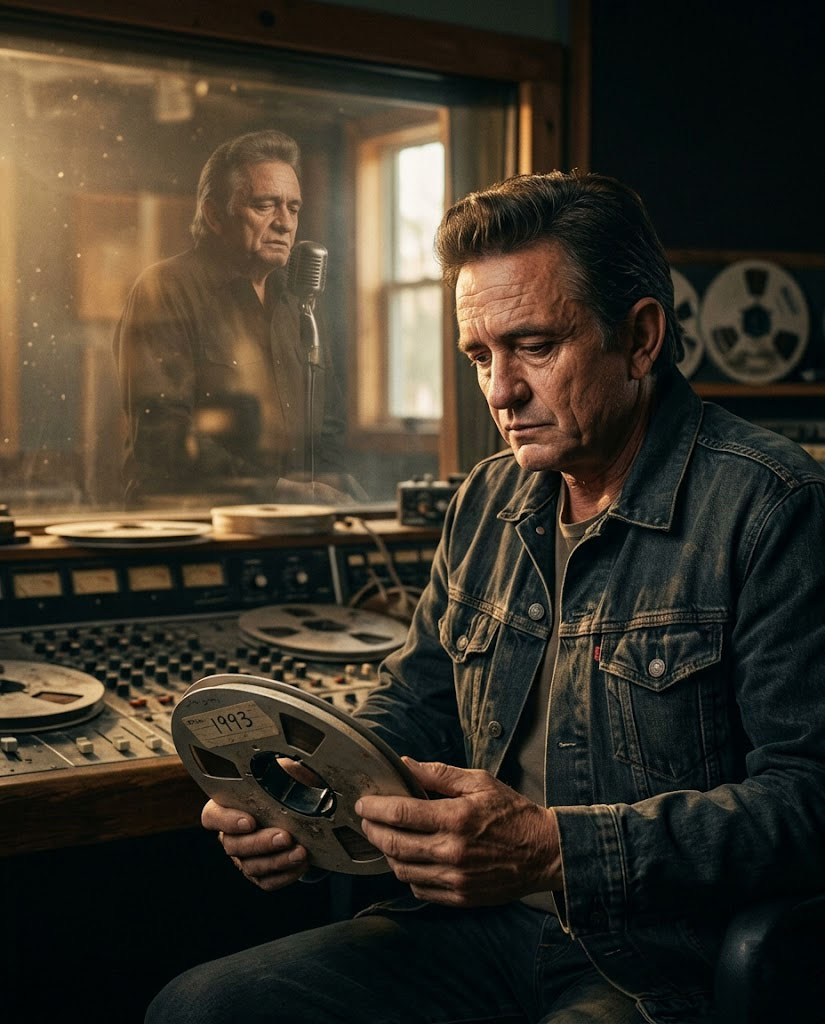
In the early months of 1993, Johnny Cash walked into LSI Studios in Nashville. He arrived without a record deal, without a marketing team, and without any promise that anyone would ever care.
He simply sat down, faced the microphone, and recorded eleven original tracks completely alone.
Nobody wanted them. The tapes were placed into a vault and left to gather dust, entirely ignored by the very industry he had helped build.
Then, in June 2024, twenty-one years after Cash took his final breath, his son John Carter Cash brought those forgotten sessions back into the light. They were finally released as the album Songwriter.
By the time Cash recorded those tracks, Music Row had already moved on.
Country radio had stopped playing his songs years earlier. His last major hit belonged to a different decade, and a new generation of executives viewed the Man in Black as an artifact from a bygone era.
In the eyes of the business, his definitive chapters had already been written.
But Cash never stopped being a writer. The absence of applause did not erase the heavy, restless thoughts in his mind.
He stepped into that studio not because the market demanded a new product. He went in because the words simply demanded to exist.
It was the quiet defiance of a man who still believed in the music, even when the business did not.
A QUIET CROSSROADS
Those intimate 1993 sessions never became the album they were meant to be.
Instead, they were boxed up and shelved. Cash moved forward, eventually finding a brilliant, stripped-down late-career resurgence with producer Rick Rubin.
But those eleven original tracks remained locked away in the shadows.
There is something profoundly revealing about that specific era. Hidden inside that vault was a version of Cash standing at an uncomfortable crossroads.
He was no longer the dangerous young outlaw, and he was not yet the revered, untouchable elder statesman.
He was just a working artist. He was a man clinging to the quiet dignity of a craft that the commercial world had abruptly discarded.
THE LATE AWAKENING
When Songwriter finally arrived in the summer of 2024, the modern reaction was overwhelming.
Musicians like Vince Gill, Marty Stuart, and Dan Auerbach carefully added their instruments to the old vocal tracks. They played alongside a ghost, backing him with a profound reverence that Nashville had once refused to give.
The critics instantly hailed the album as a stunning revelation.
They praised the raw, unhurried truth in his aging voice. Fans celebrated the return of a legend, marveling at the weight of his storytelling.
The praise is completely deserved, but it leaves behind a deeply uncomfortable truth.
If Johnny Cash had released these exact same songs back in 1993, would those same critics have paused to listen?
The honest answer is probably no.
It is remarkably easy to applaud an artist once history has already secured their legacy. It is much harder to recognize their immense value when they stand right in front of you, unfashionable and unpolished.
Songwriter is more than just a collection of beautifully salvaged tracks.
It is a heavy mirror held up to a culture that often waits until a voice is gone to finally understand its worth.
Cash did not make a mistake by writing those songs when nobody was paying attention.
He was just early.
The music was always a masterpiece, but the world needed 31 years just to catch up…